If you are looking for expert goat herders, look no further. We are certainly NOT experts. We are always looking to learn from others, but are still learning plenty from our mistakes. The following is what we are doing, but please do your own research and don’t take our word for what is best. Since we were asked what we are doing, I’m writing it down, but there are likely much better ways.
Minerals
We use the following minerals:
- Redmond Selenium 90 (Bought at Azure Standard)
- This is good for giving a full spectrum of minerals in their natural balance. To learn more about “Redmond Salt” for agriculture go to https://agriculture.redmond.com/
- The “Selenium” may not be necessary depending on our land, but it seems that adding it in won’t hurt.
- If we didn’t go with the Selenium 90 we would have ordered the basic “Redmond Fine 10“, which is the same salt but without the added Selenium and other minerals that aren’t naturally in the “Fine 10”.
- Note: For our cattle, which tend to have flies, we use “Redmond 10 with Garlic“. Our goats don’t have a fly problem, so we haven’t needed the garlic for them.
- Baking Soda (currently purchased at Costco, but we are looking into purchasing argricultural grade for cheaper)
- We also provide baking soda. This is especially helpful in the spring to prevent bloating with the wet grass.
- Kelp (not yet using)
- We have heard that providing kelp is good, but we haven’t done that yet.
Note: We buy our Redmond Salt for our animals, as well as bulk food for our family, at Azure Standard.
Mineral Feeder
We built our mineral feeder out of 4 inch PVC pipe. Ours is similar to the one at https://alifeofheritage.com/farm-living/goat-mineral-feeder/, but we made some modifications that I like. I will post more details later.
Housing
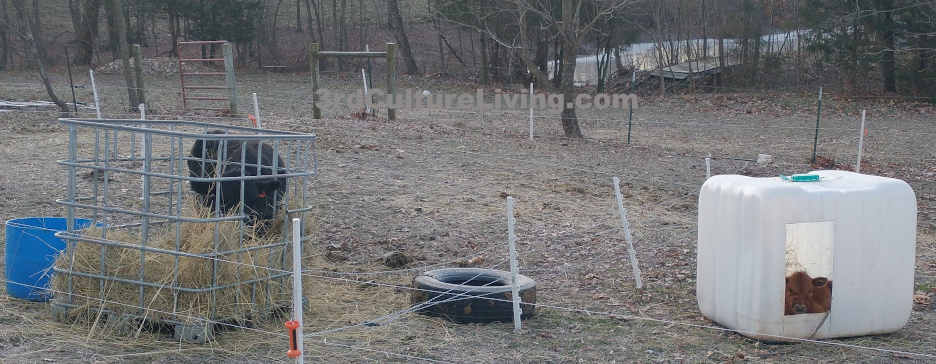
We started with goat shelters built with free wooden pallets. I wish I had learned about the simplicity of using an IBC tote first.
Our IBC tote shelters are:
- Easy to clean (roll like a giant dice to dump most contents, or squirt out with water or a pressure washer for a more thorough clean)
- Easy to move (I can pick them up and toss them over our fence)
- Easy to build (cut a hole in the side)
- Rain proof (Built to hold water)
- Wind proof (great for winter)
- Inexpensive (you don’t need the cage, only the plastic container)
- able to fit multiple goats, and to have several so each mom and her kids can have their own if they’d like
Tethering
In the late fall and early spring, when we don’t care if they munch on our fruit trees, etc. we sometimes let our goats free range. Other times I tether them to tires.
Advantages of tethering to tires
- Easy to move (roll) compared to tethering to cement blocks, which I have heard of people doing. I can put them right where I want them to clear the area.
- Can give goats some freedom. I can adjust the size/weight of the tire to anchor the goats or to give them more freedom. If I give them a very light tire, they can move fairly quickly, but still stay in the general area where I want them.
Disadvantages of tethering to tires
- Easy to tangle – since they have a chain with an anchor point, they can get themselves twisted around trees, etc. Someone needs to check on them occasionally, especially if we have them near the woods, to see if they are tangled and help them.
Notes about tethering:
- Use chain, not metal stranded rope
- Metal stranded rope breaks when twisted and has sharp edges.
- I put a loop around the tire
- 5 ft chain
- held together with a quick link
- with a bolt snap
- For the leash chain:
- 10 foot chain
- Welded chain links are better than “double loop” chain. They don’t act as a chainsaw on your hands, trees, and other things that they rub against.
- A fairly light weight chain will work and be lighter for the goats.
- with a bolt snap at the end
- 10 foot chain


