As mentioned in Elyse’s “Sheep” post, we recently introduced two sheep to our farm… at least until one of them escaped when getting it off of the truck… and then was found and safely returned after exactly one week of living in the woods with the coyotes. (No one can figure out exactly how that happened instead of some well fed coyotes. All I can say is God wanted that sheep to make it, so like Daniel in the lions’ den, their mouths were kept shut.) After they were together again we noticed that they both relaxed. We also heard that if they had not been able to be together, the sheep we had would likely have died soon since they are herd animals.

I’m not going to retell what Elyse already wrote so well, but will add a few details and things we learned.
1. Not knowing the Shepherd’s voice – In John 10:27, Jesus says, “My sheep hear my voice, and I know them, and they follow me.” As we watched the sheep run out the gate of our homestead, down the road and over the hill, this verse came immediately to mind. I realized that this sheep didn’t know where home was and didn’t know my voice at all. If anything, my voice may have a negative effect on her as she had only heard it during the stressful time of moving. This is just one of several sheep related Biblical truths that became more real to me from this event.
2. Talking to our animals – When we add new animals (especially the mammals) to the homestead, we try to make sure of two things. One, is that they know where home is. Before we move them to different areas of the property, or give them more freedom, they need to have time in their home enclosure, usually about a week. We need to see that they will rest in the housing we give them, eat from the feeders we use, etc. That way, even if things go wrong, they will know where to come when the sun goes down.
The second thing we do is to make sure that they know at least one of our voices. I sometimes call Isaiah, “Isaiah Duck”, since he takes care of the ducks and geese. They know his voice and will come to him (being well trained that a certain call means “dinner is served”). For our goats and now new sheep and dog, that means my being out with them talking with them.
Normally, I have time in God’s Word before taking care of the animals, so that I can think about it while going through the routines. When we have new animals I sometimes change that up. I quickly get up and do the routine tasks (feed in the feeders, etc.), and then go sit on a tire or other seat in the new animal’s enclosure. I then have my morning Bible time reading out loud to the new animals. I’ll usually have a bowl of treats that I put a few feet away from me and move gradually closer, to encourage the animals to come close. It usually takes a week or two before they’ll come right up to me. (Note: This is for animals such as our goats and sheep that have rarely been near people. If the animals are used to people, they may come cuddle next to us on day one.) Letting the animals know my voice, and trust my voice (bringing food helps with that), allows them to have more freedom since I know they will allow me to approach and lead them.
3. Close the gate! – Just a few weeks before bringing our sheep home, I completed fencing around our entire property, a project that we’ve been working on in spurts all spring, summer and fall. It was all set! We can let the goats have more freedom (tethered to smaller tires that they can easily move, or let loose completely)! We aren’t needing to constantly chase the geese and ducks back from the neighbors’ yards. And the neighbor’s dog, that has developed a taste for our chickens, can no longer just stroll over for a quick snack. It has been such a blessing having the fence finished.
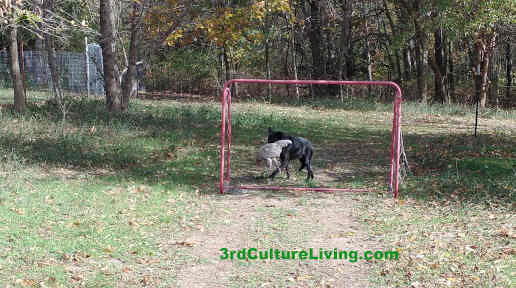
So you may be wondering, if you have this new fence, how did the sheep escape? One answer I give is that God wanted us to meet new neighbors and learn new lessons. The way it worked for that to happen is that when I got out to open the gate to enter the property and drive to the sheep enclosure I was thinking about how to unload the sheep (still a mystery to us at that point), and forgot to stop and close the gate. I don’t know if the sheep remembered, or found the gate some other way, but after escaping our grasp during unloading, it fairly quickly made its way out of the open gate, up the road and out of sight. I don’t think I will again forget the importance of closing the gate, especially where there are new animals involved.
4. Gates – As mentioned, we enclosed our whole property with fencing. One side was already done from sometime in the past, and one of our neighbors (who basically live over here and have been a great blessing) took care of their side for us. That left two sides, which is still quite a bit on seven acres. I pounded a lot of T-posts over the past few months… have we mentioned before that Missouri has a lot of rocks?. Two benefits of doing it all by hand is getting a great workout while pounding, and great time with my sons while stretching and clipping fence! (Some of the fence is clipped, but a lot of it is still just put up with plastic pull ties. We’ll work on that more in the spring.) While most of the fencing took manual labor, it was repetitive, fairly relaxing and not too hard. The thing that was the hardest to figure out was the gates.
The only picture I had in mind was the nice smooth gates in the city or on well funded farms. There was no way we could afford all the gates that we needed. One thing we love to do is to visit other farms. One of the farms, Gooseberry Bridge Farm, gave me great ideas. Unlike all of the fancy fences, etc. that I saw elsewhere, their fences and gates were all done quickly and inexpensively! Perfect! Most of our gates are now made from cutting cheap, fairly flimsy cattle panels to length, and hooking them on with quick links. Since there aren’t really any hinges we basically pick up the whole gate to swing it out of the way. This works great on the smaller walk through gates. For the larger gates to drive through it’s solid when closed (and supported on both ends), but quite floppy when open. It works for us and is MUCH less expensive than nice, hinged gates.
For a while, we had the whole fence up, but were missing a few gates (near where we park). This rendered the whole fence almost useless. Our animals quickly found that opening and would come and go freely. (Note: Most of our animals prefer to be close to us… but those geese… oh, those geese… we have very gracious neighbors.)
In the past (still today??), shepherds would coral their sheep and then lay across the opening. The shepherd himself would be the gate at night! He would know if a sheep tried to leave, or if a predator tried to enter. In John 10:9-10, Jesus says, “I am the door. If anyone enters by me, he will be saved and will go in and out and find pasture. The thief comes only to steal and kill and destroy. I came that they may have life and have it abundantly.” The gate is important. It is where things come and go. Jesus is the door. It is only through that door, that gate, that we can enter and have life! Having animals is really helping us understand and internalize so many of the farming illustrations in the Bible. It’s like every day is a new day to better know the voice of our Creator, Savior and God!
5. Moving the sheep – After the fact, I have learned that sheep have a large gap between their last teeth and the back of their mouth. I haven’t done it yet, but apparently the best way to guide them in this situation is to grab inside their mouth way in the back, and possibly with their tail as well, and they can be guided anywhere. That will be very useful information next time. :o)
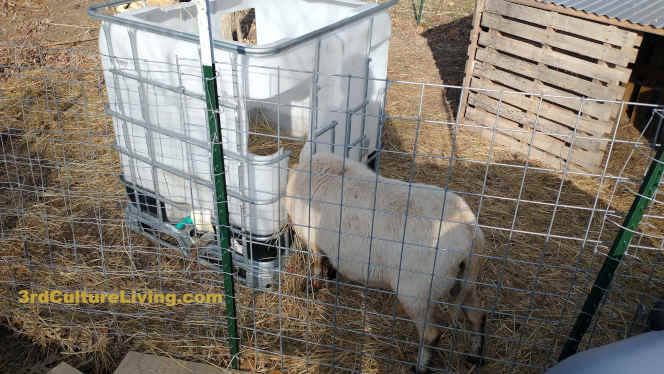
6. Housing – My new favorite homestead discovery is IBC totes. This will probably be a separate post, or string of posts, in the future. One wonderful use of IBC totes is as easily mobile housing. Simply cutting a door in the side of the tote creates a house that blocks wind and rain. I wasn’t sure if the animals would move in, but they found them quickly and really enjoy them. These totes work well with or without the metal casing. I have most of ours without the casing, to make them easy to move, but have the casing available, with doors cut, for if wind becomes an issue. (Note: The hog housing is a very different design than for the goats, sheep, and calves.)
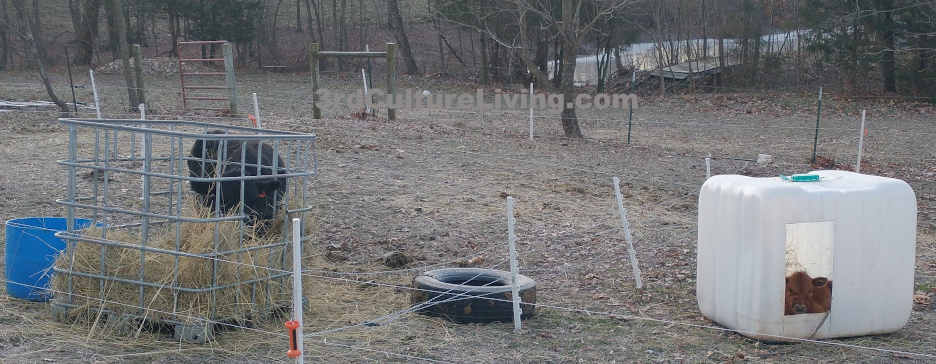
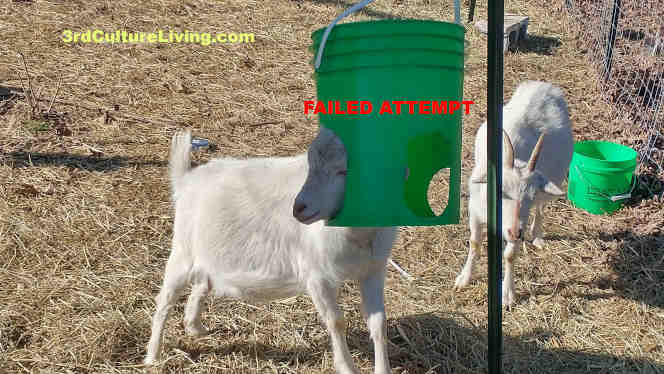
7. Feeding – Back to the IBC totes. The goats and sheep use one simple design, and the cattle use an even simpler design with just the cage. Animals, especially the goats, are known to waste much of the food they are given. (They drop it, then walk and do their business on it, then won’t eat it.) These feeders have them eating primarily in the tote, so dropped food isn’t wasted! Our waste of hay has dropped WAY down since building the IBC tote feeders. (Again, like housing, and other topics, additional posts will be coming with more details.)

8. Get to know the neighbors – There is a lot of discussion about being “Self-Sufficient” and the American idea of “Rugged Individualism”. Neither of these concepts seem to be present in the Bible, without a fair degree of twisting of Scripture. Instead I see an emphasis on being “God-Sufficient” and “Community-Suffficient”. We have been studying Esther recently, and in Esther 4:16, there is a chance for “rugged individualism”, to stoically do what needs to be done. Instead, we see Esther asking, “Go, gather all the Jews to be found in Susa, and hold a fast on my behalf, and do not eat or drink for three days, night or day. I and my young women will also fast as you do. Then I will go to the king, though it is against the law, and if I perish, I perish.” And throughout Scripture we see the instruction and example of praying for one another. In the homesteading context, it is a blessing to build community with the neighbors. This is not only for when an animal goes missing, but for support and encouragement in so many ways. We are blessed to receive, and blessed to give. We live in a wonderful community and while we are glad to be able to support and encourage in a variety of ways, the best gift we can give is the Good News of Jesus Christ. While some of our community know Christ, many do not. Please pray for us, that the Holy Spirit would be working to draw many to God himself!
While we continue to learn more from the homestead, the animals, and specifically the sheep, these are a few of the things that we have been blessed to learn so far. We are excited for all of the ways that Christ will lead us to better know our Good Shepherd’s Voice, to enter through Christ, our Door to Salvation, to learn to joyfully follow him as he feeds us through His Word, His Spirit, and His People.

 3rd Culture Living
Have thoroughly enjoyed reading Parts 1 & 2!
LikeLike