The spring is a VERY busy time of year on the homestead as everything is growing and waking up. I’m way behind on getting this update out, and it is long, but it’s exciting to recall all that has been happening. We’ll divide this update into four posts (Animals, Land, People and Other). With our primary audience being our children, it’s nice to have this record. I just reread the following, and it’s such a joy to see all that God is doing to teach, challenge and grow us to make us more like himself.
1: Animal Updates
Milking
In the last update I mentioned that we now have two cows (correction: head of cattle). We do not have 2 COWS. We have one cow (a female after having a baby), and one heifer (a female which has not yet had a baby). We also have three goats which have given birth within the past few months. The four ruminants with babies have brought what is likely the biggest change to our homestead routine… milking.
the Cow
The cow and goats have brought their unique challenges to work through.
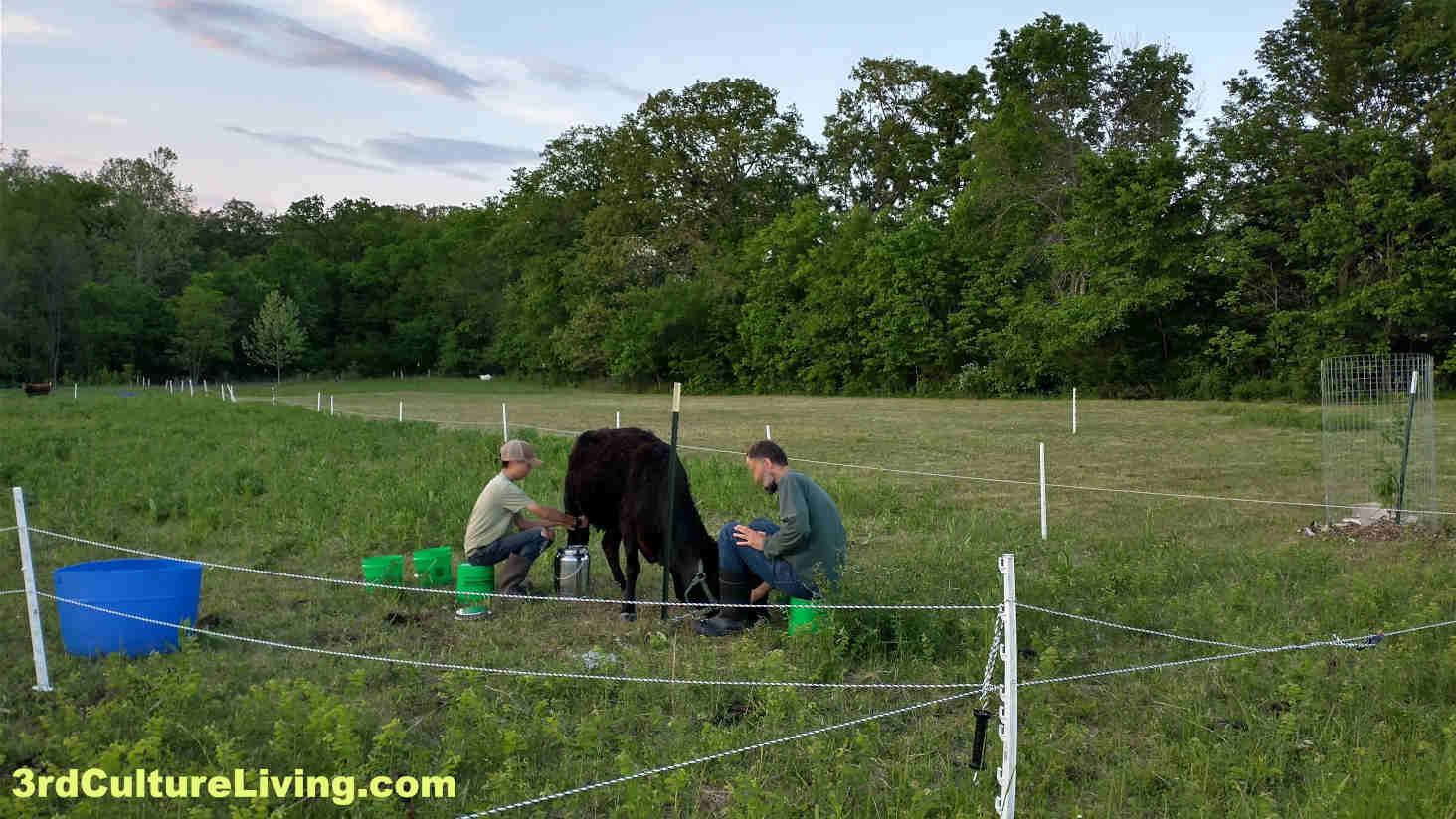
While our cow is a small dexter (see the last update), she could still squash us if she desired. She’s very gentle, so there’s not much risk of that, but still, we can’t just move her where we want her. Our first milking involved one of my sons with a bucket and me with treats. She would stay near the treats, but my son was basically chasing her in a circle trying to milk her. Funny, but not very efficient. We then tried chaining her to a tree with treats. This worked quite well (and she is perfectly happy eating), but getting her to a tree (often outside of the fence), was a flight risk and a hassle. When we were researching, most people use a stanchion, which locks the cows head, but that also seemed hard to move, etc. so we weren’t sold on it (and why learn from others failures when we can have our own :o).
We now have a system that works great for us. Our cows are grazing rotationally. They move to a new pattock every day. We do this with a single strand of electrical fence (it amazes me that that small rope keeps them in, when they could easily hop it, smash it, etc.). Roughly each week, we make a long alley of rope about 300 feet down the pasture and 40 feet across. We pound a T-post at the top of the hill and put a chain (about 8 inches) and clip at the base. Both Bonnie (the cow) and Red (the heifer) start at the top of the hill with a space ~40 feet across. They are separated (by one strand of rope) all night. The next day, we bring treats and sit on buckets next to the T-post. Bonnie happily comes on her own. While she is munching the treats, I (Rob) clip her to the post. She stays there while one of my son’s milks her. After milking, we release the chain and open the rope so she and Red can be together. Later in the day, we move the rope a little further down the hill and separate them to start the cycle again. This has worked quite well. We still have the problem of her occasionally shuffling her feet so that my son can’t milk very easily or rotating a bit around the T-post (what I call bowling for my son), but overall this has worked well, is very quick to set up and I doubt a stanchion would do any better. We’re very grateful for the cow (and heifer) that God provided.
the Goats
The goats are a different story. They too are moved everyday, but unlike the cows are easy to leash and move. We just tether them to tires and move the tires to areas with lots of forage (recently clearing an area of woods that was extremely overgrown).
To milk them we set up a stanchion in the garage (a few times milking in the rain with chickens jumping on us, in the milk, etc. taught us that something needed to change). We just leash one at a time and they know exactly what to do. They will walk right past their home and baby to the door of the garage. As soon as we open it, they walk in, jump up on the stanchion and put their head through. One of the boys then milks her while another gives treats and I hold her hind feet to keep her from stepping into the milk pail. We can then relax, talk and milk.
While we don’t have that much milk compared to the huge dairy breeds (less than a gallon a day total), we have plenty of fresh, high quality, raw milk for our family. With the abundance of milk, we’ve been able to experiment with making cheese and ice cream, as well as having plenty of milk to enjoy. We often are reminded of the truth of Proverbs 27:27, “There will be enough goats’ milk for your food, for the food of your household and maintenance for your girls.” We have seen the abundance of God’s provision, and how he created cows, goats and other ruminants to turn the solar energy caught in the grass into an abundance of healthy food for the whole homestead (even the garden likes a nutritional boost of raw milk).

Too cold for bees
We haven’t caught a swarm of bees yet. We were wondering what we did wrong… until we learned that no one else seems to be catching them either. The colder, wetter temperatures this year are keeping the bees from swarming. Hopefully we’ll provide a nice home for a swarm when the weather warms up.
Diatomaceous Earth
Goats and Cows and Parasites (Oh, my!) While we rotationally graze our animals each day (though the goats have a home base for night), parasites are still something to consider during the rainy season. We recently learned that it can be good to include Diatomaceous Earth with their feed to kill parasites. I’m not 100% convinced that this is the best, but it was recommended by several friends who know a lot more than we do (a LOT more), so we’re going with them on this one.
Ducks and chicks hatch
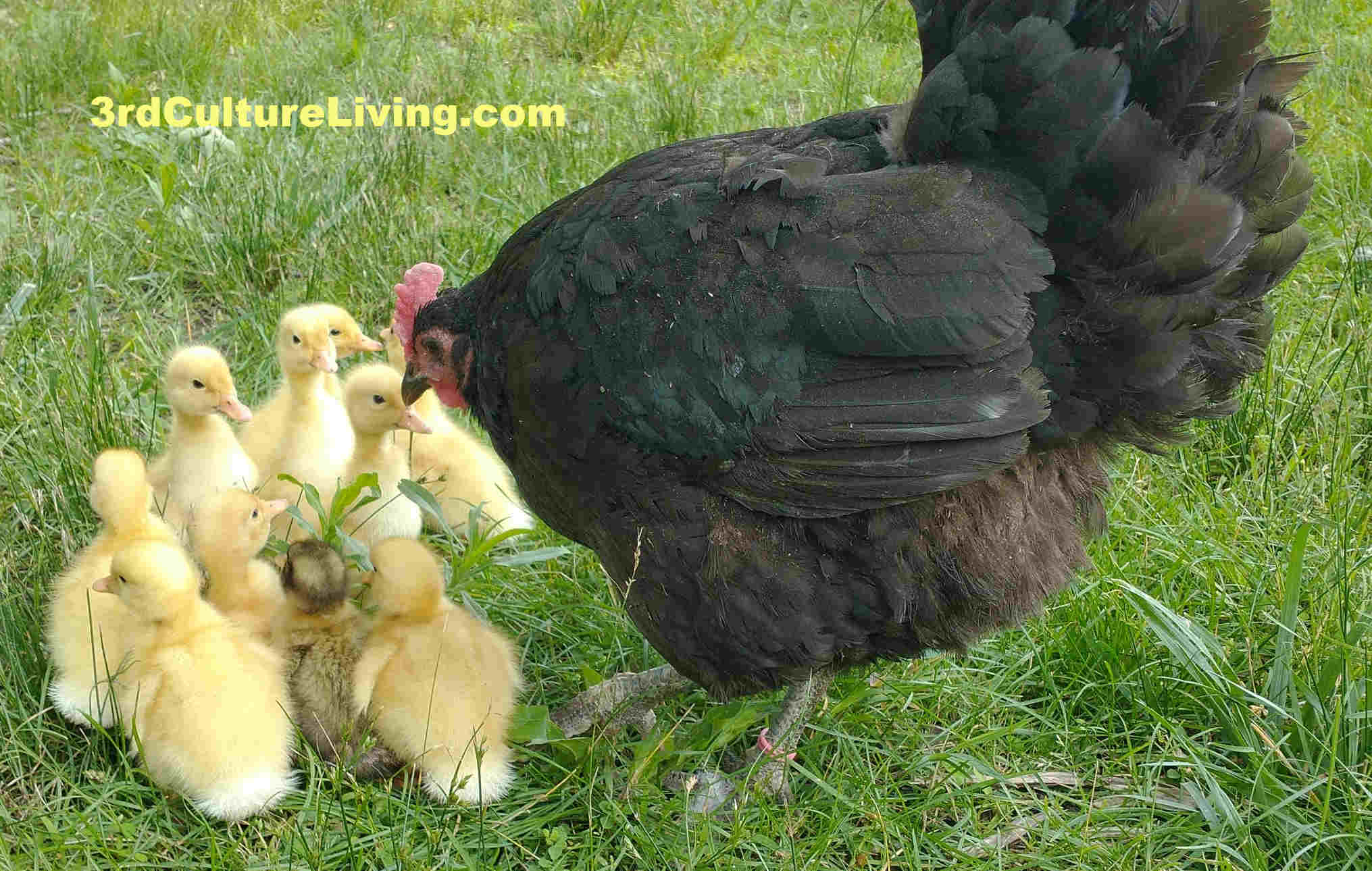
This spring we had three broody mother hens. One had 8 chicks hatch. One had 13 chicks hatch. And the last had 10 chicks hatch. It’s fun seeing the chicks since they aren’t actually (or exclusively) her eggs. The eggs could be from any of our various types of chickens, so when they hatch they are a whole mix of colors. The third momma hen had an even more interesting group of chicks. Her eggs were all duck eggs that we put under her, so now we have 10 little ducks following their momma hen around. Being ducks, they are naturally drawn to water, but can’t swim quite yet. When they are splashing around in shallow water, you can see the concern from their momma hen. In a few weeks, they will likely discover their full duckness and go off on their own, while momma hen returns to her normal routine. (This will happen for the baby chicks as well, and is normal.)
Two sets of rabbits
As well as baby ducks and chicks, we also have baby rabbits (and the goats which were mentioned in the last update). The same buck is the dad for both sets with two different does. For the one set, the buck and doe are the same type of purebred rabbit and their bunnies look just like them. The other doe is one we picked up later. She must have a mix of breeds in her. No two of her six babies look the same. We have brown, black, white, half black/white, black eyes, red eyes, etc. They’re all adorable, and all very different from one another.
One nice bonus of having a growing number of rabbits is the manure! Yep, it’s true. Rabbit manure is a nearly perfect fertilizer. Unlike other manure it can be used immediately, with no need to age for a few months/years and is made for soil and plant health.


Ducks wandering
Well, the ducks loved our pond… until the Canadian Geese moved in. The ducks have now become nomadic wanderers. They are usually around our property, but also enjoy our neighbor’s property (which seems to be perpetually wet), our other neighbor’s property (which has a small pond/swamp), and our other neighbor’s property (which… I’m not sure why they go there other than it’s somewhere where the geese are not. We are now looking into options to fence our yard (not just for the ducks). None of the neighbors mind the ducks, but we did have one get hit on the road and we don’t want any incidents (or for our goats, cattle… or toddler) to go wandering.
Canadian geese… Balance to the Land
In the last update, we mentioned the issue with the Canadian Geese. It finally got way out of hand. The goose was chasing our ducks (and everything else) well beyond it’s normal range. This goose was particularly aggressive. We finally called the Missouri Conservation Department and they were able to take care of the goose. That goose is no longer with us, which left a single mom to take care of her goslings. To our surprise, two days later a new male was with her on the pond. Canadian Geese are very smart and have lasting family relationships. We’re thinking that it may be her brother who came to help out. Sometimes (like now) some others also came to the pond. Fortunately, while that first male was very aggressive, these new geese all seem to go with the flow. The balance was returned to our property and everyone is getting along and learning to respect each other’s areas. (As a side note: When reviewing the past months as a family to prepare for this letter, the boys wanted to mention that we also have a blue heron that makes our pond home.)


 3rd Culture Living